Hantavirus Transport: International and Domestic within Japan (Infectious Diseases Control Law: Specified Pathogens, etc. / IATA DGR)
Key Points for Transporting Hantavirus
The transport of Hantavirus must comply with the following laws and regulations, depending on the mode and route of transport.
IATA Dangerous Goods Regulations (Category A / UN 2814)
Infectious Diseases Control Law (Class 3 Specified Pathogens)
Here are the key points regarding the transport of Hantavirus.
- . Key Points for Transporting Hantavirus
- 1. Compliance with IATA Dangerous Goods Regulations – Hantavirus Transport –
- 1.1. Key Packing Requirements
- 1.2. Key Document Creation Requirements
- 2. Compliance with Transport Regulations for Specified Pathogens under the Infectious Diseases Control Act – Hantavirus Transport–
- 2.1. Submission of Notification to the Public Safety Commission
- 2.2. Packing and Vehicle Requirements
- 3. FAQ & Consultations
Compliance with IATA Dangerous Goods Regulations – Hantavirus Transport –
Hantavirus falls under Category A, UN 2814 ("INFECTIOUS SUBSTANCE, AFFECTING HUMANS").
Therefore, when transporting it by air, whether internationally or domestically within Japan, packaging and documentation must be prepared in accordance with the IATA Dangerous Goods Regulations.
Additionally, depending on the quantity being transported, the types of flights that can be arranged (such as passenger aircraft or cargo-only aircraft) will vary.
Key Packing Requirements
- Use triple packaging.
- Prepare UN-certified packaging specifically designed for Category A, and always use it as a complete set. (UN-certified packaging for Category B / UN 3373 cannot be used.)
- Place dry ice or refrigerants outside the tertiary (outer) packaging. (When using an overpack, required labels and markings must also be displayed on the outside of the overpack.)
- Clearly mark shipper, consignee, emergency contact information, and net quantity on the tertiary packaging.
- Affix required labels, such as Category A infectious substance label and orientation ("This Side Up") labels.
Key Document Creation Requirements
- Preparation of Shipper's Declaration for Dangerous Goods (commonly known as DGD) is mandatory.
- Inclusion of "Dangerous Goods as per associated Shipper's Declaration" on the AWB.
- Consistency between Invoice, Packing List, and DGD.
- Consistency between markings/information on the tertiary and outer packaging and all accompanying documents.
If packaging and documentation are not prepared in accordance with the IATA Dangerous Goods Regulations, the shipment will be rejected. To avoid unnecessary issues such as temperature excursions, we recommend entrusting your transport arrangements to knowledgeable specialists.
Compliance with Transport Regulations for Specified Pathogens under the Infectious Diseases Control Act – Hantavirus Transport–
Under Japan's Act on the Prevention of Infectious Diseases and Medical Care for Patients with Infectious Diseases (Infectious Diseases Control Law), Hantavirus is classified as a Class III pathogen. Established in June 2007 (Heisei 19) to prevent bioterrorism and the outbreak or spread of serious infectious diseases, this regulatory framework controls and regulates pathogens and toxins that pose a risk to public life and health by classifying them into Classes I through IV and establishing regulations on their possession, import, and transport.
| Class I Pathogens | Class II Pathogens | Class III Pathogens | Class IV Pathogens | |
| Ebola virus, Marburg virus, Crimean-Congo hemorrhagic fever, etc. | Yersinia pestis (Plague), Bacillus anthracis (Anthrax), Botulinum toxin, etc. | Mycobacterium tuberculosis (Tuberculosis), Rabies virus, Hantavirus, etc. | Coronavirus, Vibrio cholerae (Cholera), Dengue virus, etc. | |
| Importation | Prohibited in principle | Permission Required (Prior Application) | Notification Required (Must notify within 7 days) | No Procedure Required |
| Possession | Prohibited in principle | Permission Required (Prior Application) | Notification Required (Must notify within 7 days) | No Procedure Required |
| Transportation | Notification to the Public Safety Commission | Notification to the Public Safety Commission | Notification to the Public Safety Commission | No Procedure Required |
Therefore, when transporting Group 3 pathogens within Japan, detailed rules are established, such as submitting a prior notification of transport to the Public Safety Commission and ensuring that a person with relevant knowledge accompanies the transport.
Please note that the regulations regarding the transport of specified pathogens, etc. under the Infectious Diseases Control Law apply only to overland transport; when transporting via aircraft or vessels, the Civil Aeronautics Act or the Ship Safety Act applies instead.
Submission of Notification to the Public Safety Commission
- When transporting outside the business premises, submit a notification to that effect to the Prefectural Public Safety Commission and obtain a transport certificate.
- The notification must include details such as date and time of transport, route, and vehicle information.
- During transport, it is necessary to carry the transport certificate issued by the Prefectural Public Safety Commission.
- Transport must be conducted in accordance with the transport certificate and the details stated therein (such as date, time, and route).
- The deadline for submission to the Public Safety Commission is one week prior to the start date of transport if the transport is completed within a single prefecture, and two weeks prior to the start date if it spans multiple prefectures.
Packing and Vehicle Requirements
- Use triple packaging.
- Prepare UN-certified packaging (UN specification packaging) designated exclusively for Category A and use it as a complete set. (Category B / UN3373 UN-certified packaging cannot be used.)
- Equip the transport vehicle with emergency supplies in case of accidental leakage, including Personal Protective Equipment (PPE), disinfectants, and plastic tarps (blue sheets).
- Secure the container holding the specimen with a padlock and fasten it inside the vehicle using a chain lock.
- In addition to the driver, a person with relevant knowledge is required to accompany the transport.
Failure to submit a notification for the transport of Class I, Class II, or Class III pathogens (or submitting a false notification), or failing to transport such agents in accordance with the details specified in the transport certificate, is punishable by a fine of up to 3 million yen. Furthermore, failure to comply with orders issued by the police, such as an order to stop or a directive related to an inspection, is punishable by a fine of up to 1 million yen.
FAQ & Consultations
-
What is UN-certified packaging (UN specification packaging)?
-
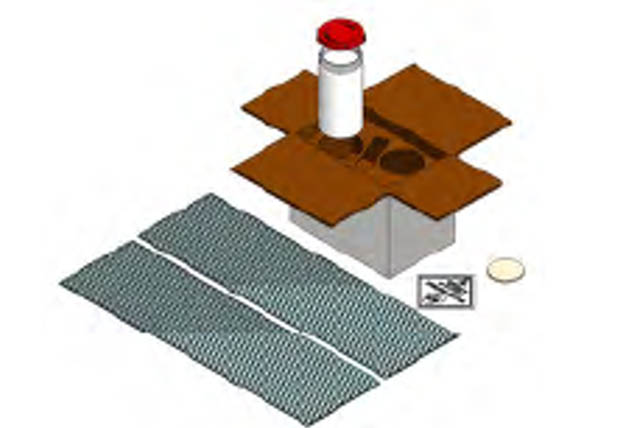
It refers to packaging that has passed safety standards (UN standards) based on recommendations established by the United Nations (UN) and is approved for the transport and storage of dangerous goods. These containers have cleared rigorous performance tests, such as drop tests, leak proofness tests, internal pressure (hydraulic) tests, and stacking tests, and are stamped or printed with a "UN Mark" indicating the applicable dangerous goods packing group, pressure resistance, year of manufacture, and other specifications.
-
I am unable to procure UN-certified packaging (UN specification packaging) on my own.
-
Jet8 offers a wide range of UN-certified packaging in various sizes. Please feel free to consult with us.
-
I want to import Dengue virus samples from Africa, but procuring dry ice, UN-certified packaging, and thermal insulation materials seems difficult.
-
Jet8 handles everything from procuring dry ice, UN-certified packaging, and thermal packaging materials to arranging transport. We also have an extensive track record of importing specimens from regions in Africa where dry ice is difficult to source. In addition to providing refrigerants and materials, we offer comprehensive door-to-door transport solutions covering on-site thermal packing, export documentation, export customs clearance, import customs clearance in Japan, and final delivery.
-
I want to import Dengue virus samples from a research partner in the United States. Can you handle the process starting from local pickup?
-
In addition to ensuring compliance with Japan’s Infectious Diseases Control Law and IATA DGR, Jet8 also researches local laws and regulations. Because many countries restrict the import and export of Category A viruses and bacteria from a biosecurity perspective, we provide full support starting from local documentation and permit applications.
-
We do not have an in-house specialist, so handling the transport of Specified Pathogens or UN2814 is difficult.
-
Jet8 has many staff members who have completed official training courses and hold certificates from IATA-accredited Dangerous Goods Training seminars. You can leave the process to us with confidence.
-
Do clinical specimens (such as blood or urine samples) from patients with diseases classified under Specified Pathogens or UN2814 need to be transported in accordance with the Infectious Diseases Control Law or IATA DGR?
-
Generally, these regulations apply when transporting the actual viruses or bacteria classified under Specified Pathogens or UN2814. However, depending on the case, patient clinical specimens may also be subject to the Infectious Diseases Control Law or IATA Dangerous Goods Regulations. Please consult with us first.
-
Do the pathogens regulated as Specified Pathogens match the pathogens classified under Category A?
-
No, they do not completely match. Some viruses and toxins are classified as Specified Pathogens even though they are not on the Category A infectious substances list. Additionally, because the classification of Specified Pathogens is subject to revision, determinations must be made based on the latest information from the Ministry of Health, Labour and Welfare (MHLW) and the United Nations (UN).
Ministry of Health, Labour and Welfare: Management Regulations for Specified Pathogens under the Infectious Diseases Control Law (Detailed Version)
-
There are no special precautions to take when transporting Class 4 Specified Pathogens within Japan, right?
-
While notification to the Public Safety Commission and accompaniment by a qualified specialist are not required, you must still comply with the statutory transport standards.
If you need assistance with the domestic within Japan or international transport of Hantavirus, please feel free to consult with us.
For inquiries, click here
For our Infectious Substances Transport service page, click here